December 02, 2025
As a specialized high-security facility, safe doors serve as a crucial line of defense for protecting valuables and cash in places like banks, jewelry stores, museums, and government agencies. As security demands continue to rise, the technical standards and functional designs of safe doors are also evolving. The following provides a comprehensive introduction to safe doors from multiple perspectives.
Definition and basic concepts
A vault door is a specialized door installed at the entrance or exit of a vault, offering a degree of vandalism resistance. It falls under the category of special anti-theft doors. According to the Chinese national standard “General Technical Requirements for Vault Doors” (GB 37481-2019), vault doors are managed by the Ministry of Public Security and subject to mandatory national standards. They are crucial equipment for crime prevention.
The basic structure of a vault door includes core components such as the door frame, door leaf, anti-theft lock, bolt mechanism, relocking device, and day gate. Additional functional modules such as time locks and waterproofing devices can be added as needed. They are designed to provide extremely high security and reliability, protecting valuables within the vault from theft and other unauthorized intrusions.
Historical evolution and development
The history of safe doors dates back to the late 19th century, when banks and insurance companies began using bulletproof and blast-proof doors. These doors were originally designed to resist forced intrusion, robbery, and armed attack. In China, the safe door industry has developed over two decades, and relevant technical standards have been continuously refined. The GB 37481-2019 standard, released in 2019, is a mandatory national standard developed based on industry experience and in light of evolving public security and counter-terrorism situations. It officially came into effect on May 1, 2020.
Product categories and levels
Classification by opening method
Safe deposit doors are primarily categorized into three types based on how they open:
Single-leaf swing safe deposit door: Consists of a single swing leaf and a fixed door frame, and is fixed and opened and closed by hinges or hinges on the side of the door.
Double-leaf swing safe deposit door: Consists of two overlapping swing leaves and a fixed door frame, and is fixed and opened and closed by hinges or hinges on the side of the door.
Sliding safe deposit door: Consists of a sliding door and a fixed door frame, and is opened and closed by the leaves moving parallel to the track. Furthermore, there are special designs for safe deposit doors with a central door, where an emergency exit door is installed on the leaf.
Classification by protection level
Vault doors are classified into several levels based on their vandalism resistance:
M: The lowest level of protection, with a net vandalism resistance of 15 minutes, and constructed using 5mm steel plates.
A: 30 minutes of vandalism resistance, constructed using 7mm steel plates, 30 minutes of violence resistance, and a fire resistance limit of 2 hours.
B: 60 minutes of vandalism resistance, constructed using 9mm steel plates, and a fire resistance limit of 4 hours.
C: The highest standard level, with a 120-minute vandalism resistance, constructed using 12mm steel plates, and a fire resistance limit of 6 hours.
D and E: These offer additional blast resistance in addition to traditional vandalism, with vandalism resistance times of 120 and 180 minutes, respectively.
Core technical features
Structural characteristics
The vault door’s structural design offers multiple protective features:
Strict overlap requirements apply to the door leaf and door frame. Single-leaf casement doors require a three-way overlap of ≥20mm, with a gap of ≤5mm.
Double-leaf casement doors require a ≥30mm overlap between the leaves, and unsprung doors are equipped with upper and lower bolts.
Sliding doors require a ≥80mm overlap between the mounting opening and the door frame, with a gap of ≤5mm.
The bolt mechanism can withstand 3000N of lateral pressure and still operate smoothly.
Safety devices
The vault door is equipped with multiple safety devices:
Relocking device: When the bolt mechanism or lock is destructively opened, it prevents the bolt mechanism from moving or prevents the door from opening.
Time lock: Mechanically or electronically prevents normal opening within a specified time period.
Day gate: A barrier located on the inside or outside of the door leaf that provides observation, ventilation, and a barrier when the vault door is open.
Locking system
Vault doors are typically equipped with two or more independently operated anti-theft locks. Common types include:
Mechanical combination locks: SG6731 mechanical combination locks imported from the United States, UL certified, with a minimum of 1,000,000 combinations.
Electronic combination locks: Can be integrated with other systems, but are susceptible to electronic failures.
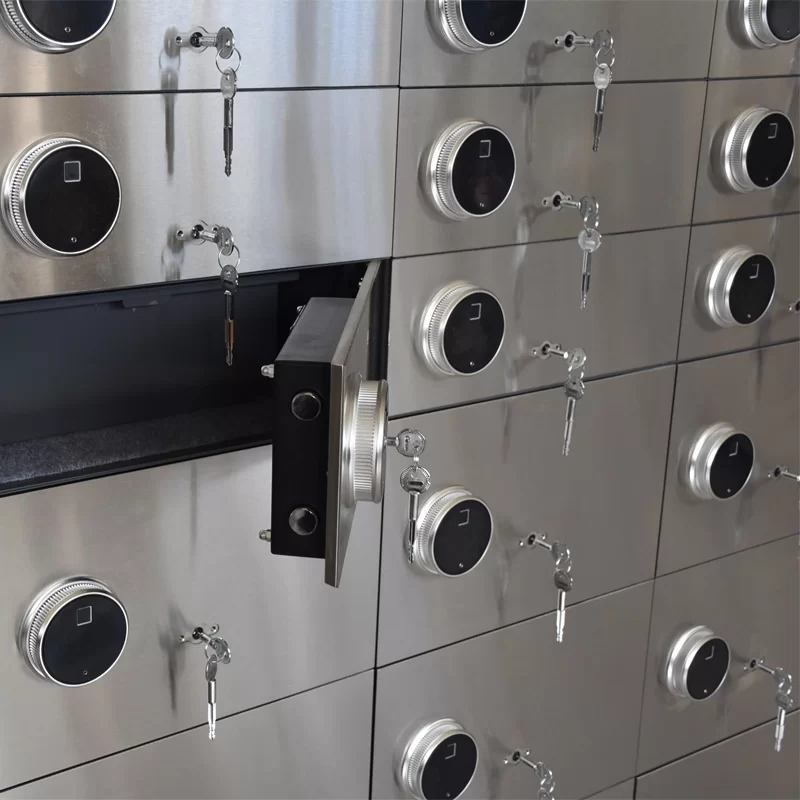
Fingerprint locks: Biometric technology enhances security.
Time locks: Limit access time.
Bank locks (dual-key locks): Require simultaneous use of two keys.
Advanced configurations may utilize a three-lock linkage system, allowing the door to be opened by opening any two of the locks. This provides both ease of operation and redundancy.
Materials and manufacturing processes
Vault doors are constructed from a variety of high-performance materials:
Stainless steel: Anti-corrosion, maintaining excellent rust resistance even in humid environments.
Special alloys: Such as Longdian special alloys, offer arc resistance, drill resistance, cut resistance, pry resistance, and fire resistance.
Composite structure: A typical structure includes a multi-layer composite structure consisting of 1.2mm thick brushed stainless steel plate, 12mm thick primary protective stainless steel plate, manganese anti-drill steel plate, and composite fireproof filler.
Strict manufacturing process requirements:
All steel components (except bearings) must undergo corrosion protection measures such as spraying and electroplating.
The surface flatness of the door frame and door leaf must be ≤3mm/m². Strict relative deviation requirements exist between the inner diagonal of the door frame and the outer diagonal of the door leaf.
Features
Modern safe doors offer multiple protection features:
Anti-theft: Defends against attacks with various tools, including standard hand tools, portable power tools, and specialized portable power tools.
Fireproof: Different levels of fire protection provide 1.5 to 6 hours of fire protection.
Waterproof: Waterproof safe doors can withstand water penetration to a depth of 5 meters for 24 hours.
Explosion-proof: Class D and E products feature enhanced blast resistance.
Anti-tailgating: Double door panels and a special locking mechanism prevent unauthorized entry.
Application Scenario
Safe deposit doors are widely used in a variety of high-security locations:
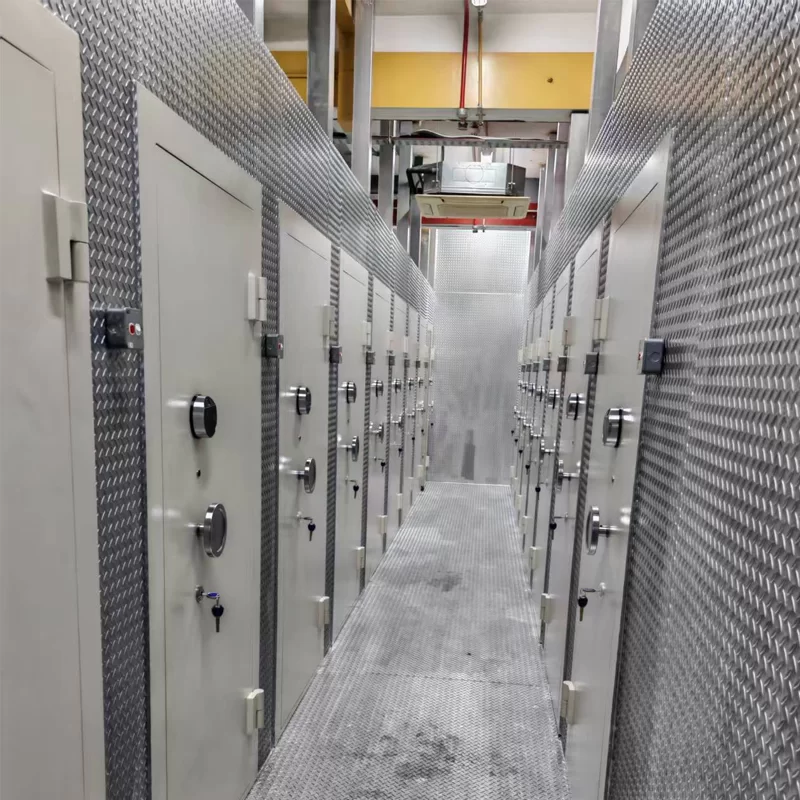
Financial institutions: Bank vaults and cash processing centers are the primary applications for safe deposit doors.
Commercial spaces: Jewelry stores, auction houses, and other locations where valuables are stored.
Cultural institutions: Museums, archives, and other locations where cultural relics and artworks are preserved.
Government facilities: Safekeeping of confidential documents, armories, and other specialized items.
Private sectors: High-end villas and private collections.
Installation and Maintenance
Installation Requirements
Safe deposit door installation has special requirements:
It must be installed on a reinforced concrete wall 300-800mm thick.
The door frame must be securely welded to the rebar extending from the wall, with the distance between adjacent welds ≤250mm. Electric sliding doors must have an anti-pinch feature and stop when encountering a resistance of ≥98N.
The installation of alarms, access control systems, and other devices must not compromise the safe deposit door’s anti-vandalism properties.
Maintenance
Proper maintenance can extend the life of your vault door:
Clean the stainless steel surface regularly with a soft cloth, avoiding the use of abrasives.
Regularly lubricate hinges, locking bolts, and other mechanical moving parts.
Open and close the door slowly to avoid impact with sharp objects.
Regularly check the function of key components, such as the lock and relock mechanism.
Hit enter to search or ESC to close